
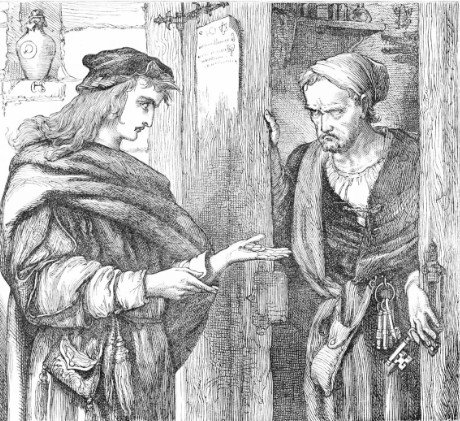
“There is thy gold, worse poison to men’s souls,
Doing more murders in this loathsome world
Than these poor compounds that thou mayst not sell
I sell thee poison; thou hast sold none.”
Act Five Scene One
This fascinating aside from Romeo, whilst pressing the apothecary to proffer him a powerful poison for his self-dispatchment, is an example of the rich universal wisdom and social commentary Shakespeare offers in the play. There are many such instances, like the Friar’s simple but sober reminder to Romeo, “love moderately”; the nurse’s proto-feminist complaint, “There’s no trust /No faith, no honesty in men; all perjured, /All forsworn, all naught, all dissemblers”; and even Romeo’s frank rebuttal of the Friar’s philosophy and learning: “Thous canst not speak of that thou dost not feel.”
The play is replete with pithy social commentary and universal truths, such is the genius of Shakespeare, but Romeo’s cutting observation above is worth exploration especially in this 2026 world of billionaires, international economic meltdowns and post-Epstein excesses.
Here Shakespeare juxtaposes gold and poison, an analogy that early audiences would appreciate, and even Puritans would find merit in observing. The poison Romeo is after will dispatch of him and even twenty others, such is the strength the apothecary tells him. We could surmise that this poison was extracted from some deadly creature that Verona society may have contact with or which could have been sourced in those days. Furthermore, the apothecary warns Romeo that Verona’s law could indict him severely for offering it to anyone for sale. However, the poor dispenser relents as his “poverty” and not his “will, consents” illustrating the abject quality of life that your average herbalist or apothecary would have faced some four hundred years ago. Compare that to the healthy business and profits that chemists, pharmacists and of course the pharmaceutical corporations experience nowadays.
What a reminder! Even for us now in 2026: “There is thy gold, worse poison to men’s souls…” The apothecary’s poison could dispatch of twenty, the greed for gold, wealth and mammon could destroy whole societies, whole continents, whole epochs.
In this scene, Romeo believes he has lost his true love, and now nothing means anything to him, especially gold. He lavishes Balthasar with a monetary gift before entering Juliet’s resting place in act five scene three, for there is nothing more precious for him than love. Shakespeare shows us perfectly that he is in the throes of love madness which cannot end but tragically.
But Romeo’s line is a powerful reminder to subsequent audiences that wealth is a noxious element in the world, symbolised by gold, and that love itself is a true bounty “as boundless as the sea” as Juliet announces in the famous Act two scene two. Pursuing these ideals is healthier, truer, freer than replenishing the lowest and darkest desires of the human soul.
We in 2026 would be wise to ponder and dwell on Romeo’s warning about gold; consider how this poison can enter the veins of a body and a body-politic; how this poison transmogrifies into others: sexual abuse; propaganda; hatred of the ‘other’; Machiavellian murder and assassination; rape of the earth; oppression; genocide; obsession.
Gold is indeed worse poison to us. An interesting subtext of the play is that Capulet arguably wants his wealth to flow into another wealthy channel, Paris, which is partly why he sees Juliet as the “hopeful lady of [his] earth”. A marriage with Paris could have mutual, material benefit for both parties. Thus, the pursuit of greater wealth and status is the greatest impediment to cosmic love and unconditional devotion.
We in 2026 would be well-advised to observe and to consider whether the poison of gold is the real origin of the call to arms, and patriotism that many are professing more ethusiastically these days via mass media. A rich man recently said that his country had been colonised by immigrants, who were draining his country’s economy. And many others like him on their multi-billion media platforms are now professing their love for their culture and country, trying to put Romeo’s love for Juliet to shame. I wonder whether they would be as generous as Romeo in his final hours for the sake of their beloved country.
Watch out for the poison of gold, clothing itself in poetry of the patriotism.